Back to all articles
Guide
IPTV Glossary (2026): Every Term You'll See, Explained Simply
· 6 min read
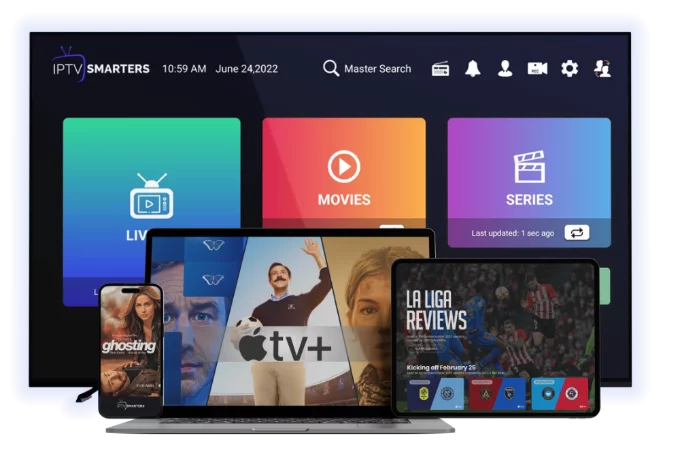
Welcome to IPTV in plain English.
Every term you'll meet researching, signing up for or troubleshooting IPTV — explained without the jargon. Bookmark this page; come back when something confuses you.
---
Watching TV channels and films delivered over the internet, instead of cable, satellite or aerial. Same TV — different pipe. See [what is IPTV](/blog-details/what-is-iptv-and-how-it-works).
TV channels that broadcast in real time — sports, news, kids' channels. As opposed to VOD (on-demand). The schedule is fixed; if you miss something you need catch-up.
Films and TV series you watch whenever you want, like Netflix. Quality IPTV providers carry tens of thousands of films and complete TV series alongside live channels.
The previous 1–7 days of a live channel are recorded and viewable on demand. Missed last night's match? Catch-up plays it from the start. Not all providers offer catch-up.
The TV listings — what's on now, next, and the next 7 days. Loaded as a separate file (XMLTV) by your IPTV app. See [EPG setup guide](/blog-details/iptv-epg-guide).
The file format used to deliver EPG data. A `.xml` or `.xml.gz` URL your IPTV app downloads and parses to display the schedule.
A playlist file (text format) listing channels and their stream URLs. Universally supported by every IPTV player. See [M3U vs Xtream Codes](/blog-details/iptv-m3u-vs-xtream-codes).
A login system for IPTV that uses Server URL + Username + Password (instead of one long M3U URL). Loads EPG, films and series automatically. Works with TiviMate, IPTV Smarters and most modern players.
The IPTV protocol used by MAG and older Formuler boxes. Authenticated by MAC address. The provider controls the channel list and EPG server-side. See [IPTV on MAG](/blog-details/iptv-on-mag-box).
A purpose-built IPTV set-top box running a stripped-down Linux. Connects to a Stalker portal. Models: MAG 524, MAG 540, etc. Lean and fast for IPTV-only households.
Modern IPTV-focused set-top boxes running Android with a custom IPTV launcher (MyTVOnline 3). Top model in 2026: Formuler Z11 Pro Max. Like a MAG box but with Netflix and Plex available too.
Amazon's streaming dongle. Cheap, popular for IPTV because it allows sideloading IPTV Smarters Pro outside the official store. See [IPTV on Firestick](/blog-details/how-to-install-iptv-on-firestick).
Modern TVs run an operating system: Samsung uses Tizen, LG uses webOS, others run Google TV / Android TV. Each has its own IPTV apps. See [IPTV on Smart TV](/blog-details/how-to-install-iptv-on-smart-tv).
A separate device (Apple TV, NVIDIA Shield, Firestick) that plugs into your TV's HDMI. Adds smart capabilities (and IPTV apps) to dumb TVs, or replaces a slow Smart TV's built-in apps.
The current 4K video codec. Compresses 4K to about half the bandwidth of older H.264. Hardware decoders are in every device since 2017. See [4K IPTV requirements](/blog-details/4k-iptv-requirements).
The legacy video codec from 2003. Plays on everything but uses more bandwidth than HEVC. Being phased out for 4K but still common for HD live channels.
The newest video codec — royalty-free, 30% better than HEVC. Hardware support: iPhone 15 Pro+, Apple Silicon M3+, NVIDIA RTX 30+, 2022+ Smart TVs.
3840 × 2160 resolution — four times the pixels of Full HD. The standard high-end picture quality in 2026.
Brighter highlights, deeper blacks, more colours than standard dynamic range. Formats: HDR10, HDR10+, Dolby Vision.
HDMI 2.0 supports 4K @ 60 Hz with HDR. HDMI 2.1 adds 4K @ 120 Hz and eARC. HDMI 1.4 caps at 4K @ 30 Hz — too slow for sport.
The pause/loading icon when a stream can't keep up with playback. Cause: slow internet, weak Wi-Fi, busy provider server, or weak device. See [why your IPTV is buffering](/blog-details/why-your-iptv-buffering).
The amount of data per second a stream uses. 4K HEVC live: 12–18 Mbps. 4K HEVC sport: 18–22 Mbps. Higher bitrate = better quality, more bandwidth needed.
Delay between live broadcast and what you see. IPTV typically adds 15–45 seconds vs cable/satellite. Lower latency = closer to real-time.
- Unicast: every viewer gets their own stream from the server (most consumer IPTV)
- Multicast: one stream to many viewers on the same network (some EU providers, rare on consumer IPTV)
Server-side conversion of one stream to another format/quality on demand. Used to deliver multiple resolutions to different devices. Adds latency and server cost.
- Encoder: turns raw video into a compressed stream (provider-side)
- Decoder: turns compressed stream back into video (your device-side)
- Hardware decoders are dedicated silicon = smooth playback. Software decoders use CPU = stuttering on slow devices.
Installing an app on a device from outside the official store. Common on Firestick (IPTV Smarters not in Amazon Store) and Apple TV via TestFlight.
Modifying a device to install unsigned apps. Common with older Firesticks, jailbroken to add IPTV apps. Modern Firesticks allow sideloading without jailbreak.
Encrypts your traffic and routes it through another country's server. Useful for IPTV when ISPs throttle streaming or geo-restrict content. See [VPN with IPTV](/blog-details/how-to-use-vpn-with-iptv).
Your internet provider deliberately slowing certain traffic types (P2P, video streaming) at peak times. UK BT, Virgin, EE, US Comcast all do it. A VPN bypasses throttling.
Internet Service Provider — the company supplying your internet (BT, Sky, Virgin, Comcast, AT&T, etc.).
Successive Wi-Fi standards. Wi-Fi 6 = real-world ~200 Mbps; 6E adds 6 GHz band; 7 (early 2026 hardware) adds further bandwidth. Buy Wi-Fi 6 minimum for 4K IPTV.
Router setting that prioritises certain traffic. Set IPTV traffic to highest priority so it doesn't buffer when someone else on the network downloads. See [router optimization](/blog-details/iptv-router-optimization).
A direct link to a specific channel or video. Looks like `http://server.tld:8080/live/USER/PASS/12345.ts`. Can be played in VLC for testing.
Premium one-off events (boxing, UFC, WrestleMania) usually £20+ on cable. Often included for free on premium IPTV plans.
A loose term for higher-tier IPTV with PPV, full sports, large VOD library, multiple connections. As opposed to "basic IPTV" which is just live channels.
A test period (typically 24 hours) on full IPTV access without payment. Used to verify channels, picture quality and stability before committing. We offer one — [start a free trial](/free-trial).
Time-based access to IPTV: monthly, quarterly, half-yearly, annual or 2-year. Longer plans typically save 50–80% vs monthly. See [pricing](/pricing).
A middleman who buys IPTV credentials in bulk from a panel and resells them under their own brand. Lower prices but uncertain support.
The provider's back-end software that issues IPTV credentials, manages channels and tracks subscriptions. Most consumer providers run on Xtream UI panels.
A distributed server network that caches video close to viewers, reducing latency and buffering. Quality IPTV uses CDNs; budget IPTV often doesn't.
Sending Dolby Digital / DTS audio untouched from IPTV app to AV receiver. Required for surround sound. Set in app: Audio Output → Passthrough.
Watching IPTV in a small window while doing something else. Supported on Apple TV, iPad, modern Smart TVs and TiviMate.
Adjustment in IPTV apps to fix wrong-time TV listings due to timezone mismatches. Set offset (e.g. +1 for BST, -5 for EST).
Metadata in M3U files that links a channel to its EPG entry. Mismatched tags = no EPG for that channel.
---
Want to test IPTV with all these features?
[Start a 24-hour free trial](/free-trial). Xtream Codes login emailed in 5 minutes. Test on whatever device you have, then come back to this page when something on screen says a word you don't recognise.
For specific topics see [best IPTV players 2026](/blog-details/best-iptv-players-2026), [4K IPTV requirements](/blog-details/4k-iptv-requirements) and [IPTV vs cable](/blog-details/iptv-vs-cable-tv).
Every term you'll meet researching, signing up for or troubleshooting IPTV — explained without the jargon. Bookmark this page; come back when something confuses you.
---
1. IPTV (Internet Protocol Television)
Watching TV channels and films delivered over the internet, instead of cable, satellite or aerial. Same TV — different pipe. See [what is IPTV](/blog-details/what-is-iptv-and-how-it-works).
2. Live TV
TV channels that broadcast in real time — sports, news, kids' channels. As opposed to VOD (on-demand). The schedule is fixed; if you miss something you need catch-up.
3. VOD (Video on Demand)
Films and TV series you watch whenever you want, like Netflix. Quality IPTV providers carry tens of thousands of films and complete TV series alongside live channels.
4. Catch-up TV
The previous 1–7 days of a live channel are recorded and viewable on demand. Missed last night's match? Catch-up plays it from the start. Not all providers offer catch-up.
5. EPG (Electronic Programme Guide)
The TV listings — what's on now, next, and the next 7 days. Loaded as a separate file (XMLTV) by your IPTV app. See [EPG setup guide](/blog-details/iptv-epg-guide).
6. XMLTV
The file format used to deliver EPG data. A `.xml` or `.xml.gz` URL your IPTV app downloads and parses to display the schedule.
7. M3U / M3U8
A playlist file (text format) listing channels and their stream URLs. Universally supported by every IPTV player. See [M3U vs Xtream Codes](/blog-details/iptv-m3u-vs-xtream-codes).
8. Xtream Codes API
A login system for IPTV that uses Server URL + Username + Password (instead of one long M3U URL). Loads EPG, films and series automatically. Works with TiviMate, IPTV Smarters and most modern players.
9. Stalker portal
The IPTV protocol used by MAG and older Formuler boxes. Authenticated by MAC address. The provider controls the channel list and EPG server-side. See [IPTV on MAG](/blog-details/iptv-on-mag-box).
10. MAG box
A purpose-built IPTV set-top box running a stripped-down Linux. Connects to a Stalker portal. Models: MAG 524, MAG 540, etc. Lean and fast for IPTV-only households.
11. Formuler
Modern IPTV-focused set-top boxes running Android with a custom IPTV launcher (MyTVOnline 3). Top model in 2026: Formuler Z11 Pro Max. Like a MAG box but with Netflix and Plex available too.
12. Firestick / Fire TV
Amazon's streaming dongle. Cheap, popular for IPTV because it allows sideloading IPTV Smarters Pro outside the official store. See [IPTV on Firestick](/blog-details/how-to-install-iptv-on-firestick).
13. Smart TV (Tizen / webOS)
Modern TVs run an operating system: Samsung uses Tizen, LG uses webOS, others run Google TV / Android TV. Each has its own IPTV apps. See [IPTV on Smart TV](/blog-details/how-to-install-iptv-on-smart-tv).
14. Streaming box
A separate device (Apple TV, NVIDIA Shield, Firestick) that plugs into your TV's HDMI. Adds smart capabilities (and IPTV apps) to dumb TVs, or replaces a slow Smart TV's built-in apps.
15. HEVC (H.265)
The current 4K video codec. Compresses 4K to about half the bandwidth of older H.264. Hardware decoders are in every device since 2017. See [4K IPTV requirements](/blog-details/4k-iptv-requirements).
16. H.264 (AVC)
The legacy video codec from 2003. Plays on everything but uses more bandwidth than HEVC. Being phased out for 4K but still common for HD live channels.
17. AV1
The newest video codec — royalty-free, 30% better than HEVC. Hardware support: iPhone 15 Pro+, Apple Silicon M3+, NVIDIA RTX 30+, 2022+ Smart TVs.
18. 4K UHD
3840 × 2160 resolution — four times the pixels of Full HD. The standard high-end picture quality in 2026.
19. HDR (High Dynamic Range)
Brighter highlights, deeper blacks, more colours than standard dynamic range. Formats: HDR10, HDR10+, Dolby Vision.
20. HDMI 2.0 / 2.1
HDMI 2.0 supports 4K @ 60 Hz with HDR. HDMI 2.1 adds 4K @ 120 Hz and eARC. HDMI 1.4 caps at 4K @ 30 Hz — too slow for sport.
21. Buffering
The pause/loading icon when a stream can't keep up with playback. Cause: slow internet, weak Wi-Fi, busy provider server, or weak device. See [why your IPTV is buffering](/blog-details/why-your-iptv-buffering).
22. Bitrate
The amount of data per second a stream uses. 4K HEVC live: 12–18 Mbps. 4K HEVC sport: 18–22 Mbps. Higher bitrate = better quality, more bandwidth needed.
23. Latency
Delay between live broadcast and what you see. IPTV typically adds 15–45 seconds vs cable/satellite. Lower latency = closer to real-time.
24. Multicast vs Unicast
- Unicast: every viewer gets their own stream from the server (most consumer IPTV)
- Multicast: one stream to many viewers on the same network (some EU providers, rare on consumer IPTV)
25. Transcoding
Server-side conversion of one stream to another format/quality on demand. Used to deliver multiple resolutions to different devices. Adds latency and server cost.
26. Encoder / Decoder
- Encoder: turns raw video into a compressed stream (provider-side)
- Decoder: turns compressed stream back into video (your device-side)
- Hardware decoders are dedicated silicon = smooth playback. Software decoders use CPU = stuttering on slow devices.
27. Sideloading
Installing an app on a device from outside the official store. Common on Firestick (IPTV Smarters not in Amazon Store) and Apple TV via TestFlight.
28. Jailbreaking
Modifying a device to install unsigned apps. Common with older Firesticks, jailbroken to add IPTV apps. Modern Firesticks allow sideloading without jailbreak.
29. VPN (Virtual Private Network)
Encrypts your traffic and routes it through another country's server. Useful for IPTV when ISPs throttle streaming or geo-restrict content. See [VPN with IPTV](/blog-details/how-to-use-vpn-with-iptv).
30. ISP throttling
Your internet provider deliberately slowing certain traffic types (P2P, video streaming) at peak times. UK BT, Virgin, EE, US Comcast all do it. A VPN bypasses throttling.
31. ISP
Internet Service Provider — the company supplying your internet (BT, Sky, Virgin, Comcast, AT&T, etc.).
32. Wi-Fi 6 / 6E / 7
Successive Wi-Fi standards. Wi-Fi 6 = real-world ~200 Mbps; 6E adds 6 GHz band; 7 (early 2026 hardware) adds further bandwidth. Buy Wi-Fi 6 minimum for 4K IPTV.
33. QoS (Quality of Service)
Router setting that prioritises certain traffic. Set IPTV traffic to highest priority so it doesn't buffer when someone else on the network downloads. See [router optimization](/blog-details/iptv-router-optimization).
34. Stream URL
A direct link to a specific channel or video. Looks like `http://server.tld:8080/live/USER/PASS/12345.ts`. Can be played in VLC for testing.
35. PPV (Pay-Per-View)
Premium one-off events (boxing, UFC, WrestleMania) usually £20+ on cable. Often included for free on premium IPTV plans.
36. Premium IPTV
A loose term for higher-tier IPTV with PPV, full sports, large VOD library, multiple connections. As opposed to "basic IPTV" which is just live channels.
37. Free trial
A test period (typically 24 hours) on full IPTV access without payment. Used to verify channels, picture quality and stability before committing. We offer one — [start a free trial](/free-trial).
38. Subscription / Plan
Time-based access to IPTV: monthly, quarterly, half-yearly, annual or 2-year. Longer plans typically save 50–80% vs monthly. See [pricing](/pricing).
39. Reseller
A middleman who buys IPTV credentials in bulk from a panel and resells them under their own brand. Lower prices but uncertain support.
40. Panel
The provider's back-end software that issues IPTV credentials, manages channels and tracks subscriptions. Most consumer providers run on Xtream UI panels.
41. CDN (Content Delivery Network)
A distributed server network that caches video close to viewers, reducing latency and buffering. Quality IPTV uses CDNs; budget IPTV often doesn't.
42. Audio passthrough
Sending Dolby Digital / DTS audio untouched from IPTV app to AV receiver. Required for surround sound. Set in app: Audio Output → Passthrough.
43. PiP (Picture in Picture)
Watching IPTV in a small window while doing something else. Supported on Apple TV, iPad, modern Smart TVs and TiviMate.
44. EPG timeshift
Adjustment in IPTV apps to fix wrong-time TV listings due to timezone mismatches. Set offset (e.g. +1 for BST, -5 for EST).
45. Tag / tvg-id
Metadata in M3U files that links a channel to its EPG entry. Mismatched tags = no EPG for that channel.
---
Want to test IPTV with all these features?
[Start a 24-hour free trial](/free-trial). Xtream Codes login emailed in 5 minutes. Test on whatever device you have, then come back to this page when something on screen says a word you don't recognise.
For specific topics see [best IPTV players 2026](/blog-details/best-iptv-players-2026), [4K IPTV requirements](/blog-details/4k-iptv-requirements) and [IPTV vs cable](/blog-details/iptv-vs-cable-tv).
Frequently asked questions
Netflix is purely VOD (on-demand films and series). IPTV is primarily live TV channels — sports, news, kids — usually with a smaller VOD library bundled in. Quality IPTV providers offer both: live channels plus tens of thousands of on-demand films.
Xtream Codes is a login system for IPTV using three credentials (Server URL + Username + Password). Originally a panel software, the name has become shorthand for "the modern IPTV API". Most quality IPTV apps support it and load EPG/VOD automatically.
HEVC (H.265) is the modern 4K video codec — uses about half the bandwidth of older H.264 for the same picture quality. Every device built since 2017 hardware-decodes HEVC. Without HEVC support, 4K IPTV will stutter.
The IPTV protocol used by MAG boxes and older Formuler models. Authenticated by MAC address (instead of username/password). The provider controls the channel list and EPG server-side. See our IPTV on MAG box guide for setup.
Pay-Per-View — premium one-off events like boxing, UFC and wrestling that cost £19.95+ on Sky / cable. Most premium IPTV plans include PPV events at no extra charge on dedicated channels.
#glossary
#terms
#beginners
#reference