Back to all articles
Performance
Why Your IPTV Keeps Buffering (And How to Stop It Permanently)
· 4 min read
1. Why buffering happens in plain English
Buffering means your IPTV player is asking for video faster than your internet can deliver it. The video pauses while the player waits for more data to arrive. Once you understand that, fixing it is just about removing whatever's blocking that flow — and it's almost always one of eight things.
2. Cause 1: slow or unstable internet (the #1 culprit)
You need at least 15 Mbps for stable HD and 25 Mbps for 4K. Run a speed test at fast.com — and be honest about the result. Most "my IPTV is bad" complaints turn out to be 8–10 Mbps connections that simply can't keep up.
Fix:
- Restart your router (unplug 30 seconds, plug back in)
- Test on wired ethernet to rule out Wi-Fi
- If you're consistently below 15 Mbps, talk to your ISP about an upgrade — fibre is now £25–£35/month in most of the UK and worth it
3. Cause 2: weak Wi-Fi signal
Even with fast internet, a weak Wi-Fi signal will buffer constantly. The TV is in the next room, walls and microwaves get in the way, and 2.4GHz Wi-Fi is slow.
Fix:
- Move your router closer to the TV (or vice versa)
- Switch to the 5GHz band — usually a separate Wi-Fi network ending in "-5G"
- Add a mesh node (Eero, Deco, Google Nest Wifi) — under £100 for a transformative improvement
- Use a powerline ethernet adapter if running a cable isn't possible — TP-Link AV2000 or similar
4. Cause 3: ISP throttling IPTV traffic
This is increasingly common in the UK and EU. ISPs detect IPTV-style traffic and quietly slow it down. The tell-tale sign: IPTV works fine on your phone's mobile data but buffers on home Wi-Fi.
Fix:
- Change your DNS to 1.1.1.1 (Cloudflare) or 8.8.8.8 (Google) — instant for many users
- If DNS doesn't fix it, use a VPN — NordVPN, Surfshark or ProtonVPN are all reliable with IPTV
- Set the VPN to a server in the same country as your IPTV provider's infrastructure
5. Cause 4: too many devices on the network
A 4K stream, a kid on Roblox, an iPhone backup, and a console downloading an update will saturate even a 100 Mbps connection.
Fix:
- Enable QoS (Quality of Service) on your router and prioritise your TV
- Pause backups during prime viewing hours
- Schedule console / PC downloads for overnight
6. Cause 5: weak streaming hardware
The original Fire TV Stick (non-4K) struggles with modern IPTV. Older Android boxes from 2018-19 don't have the RAM. Even some smart TV apps are simply badly optimised.
Fix:
- Use a Fire TV Stick 4K Max (£60) — the best price/performance for IPTV
- Or an NVIDIA Shield TV (£150) — if you want absolute best
- Avoid no-name "Android TV boxes" sold for £30 on Amazon — they're slow
7. Cause 6: overloaded IPTV server
Sometimes it's not you. Cheap unlicensed providers oversell server capacity, so during peak hours (8–11pm) everything crawls.
Fix:
- Ask your provider about server load and which server you're connected to
- Quality providers run multiple servers and route you to the least loaded
- If buffering is consistent at peak times, it's a provider problem — switch
8. Cause 7: outdated or wrong IPTV app
Some apps just buffer more than others. The current best players in 2026:
- TiviMate (Android TV) — most stable
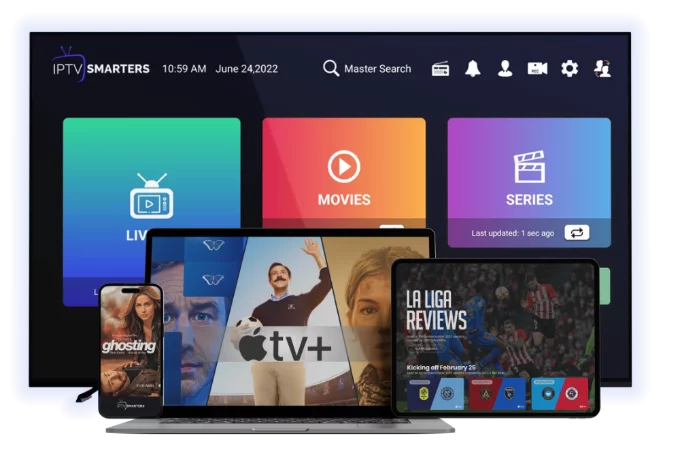
- IPTV Smarters Pro (free, all platforms) — solid free option
- Smart IPTV (Samsung/LG) — best for those TVs
Avoid no-name forks of old IPTV apps — they often have outdated streaming engines.
9. Cause 8: incorrect player settings
Even a good app on good hardware will buffer with bad settings.
Fix — set these once on each device:
- Buffer size: 3–5 seconds (not 10 — too long is as bad as too short)
- Decoder: Hardware first, fallback to software
- Network timeout: 30 seconds
- Auto-reconnect: ON
- Live timeshift: OFF if you don't use it (saves CPU)
10. The 10-minute IPTV stability checklist
Run through this once and you'll fix 90% of buffering for good:
1. Speed test ≥ 25 Mbps ✓
2. Connected via ethernet, not Wi-Fi ✓ (or 5GHz close to router)
3. DNS set to 1.1.1.1 ✓
4. Firestick 4K Max or better ✓
5. Latest app version ✓
6. Buffer size set to 3–5 seconds ✓
7. No other heavy bandwidth users ✓
8. Provider allows your IP / has spare server capacity ✓
11. When to switch providers
If you've nailed the checklist above and you're still buffering 3+ times a week, the provider is the problem. Reliable, licensed IPTV should buffer less than Netflix — that's the bar. If yours is worse, switch.
[Try IPTVFree24 free for 24 hours](/free-trial) — 22,000+ channels with multi-server load balancing and 4K streams that actually hold up at peak hours. No card needed for the trial.
For more, see [common IPTV problems and fixes](/blog-details/common-iptv-issues-and-fixes) and [the best IPTV players 2026](/blog-details/best-iptv-players-2026).
Frequently asked questions
This is usually peak-hour server overload at your IPTV provider, or your ISP throttling streaming traffic during prime time. Try changing DNS to 1.1.1.1, or use a VPN to bypass throttling.
A VPN helps if your ISP is throttling IPTV (common in the UK). It won't help if buffering is caused by slow Wi-Fi, weak hardware, or an oversold IPTV server.
Between 3 and 5 seconds. Lower than 3 causes constant micro-buffering. Higher than 5 makes channel changes feel sluggish without solving anything.
Yes, significantly. Ethernet is more stable, has zero packet loss, and is faster. If you can run a cable to your TV, do it. A powerline adapter is the next best option.
Yes — the Firestick 4K Max has more RAM and a faster decoder than the basic Firestick. For IPTV, it's the single best £60 you can spend on streaming hardware.
#buffering
#performance
#wifi
#troubleshooting